
Java Desktop App - Stock Market Simulator
Project description
In this project, we have created a Java Swing GUI application that simulates a trading day of a simplified model of a stock market:
- You can try the app by downloading the Java Jar file from Media:SMSimulator.zip
- Github repository: https://github.com/adeloaleman/stock-market-simulator
Trading Day Simulation:
- To perform the simulation, the system first creates a number of companies with random values for «number of shares» and «share price». Then, it creates a number of investors with a random «budget».
- The simulator follows these rules:
- If a company sells 10 shares, its share price doubles.
- If any 10 shares are sold (from any company) and a company hasn't sold any, its price is halved.
- Investors can perform as many transactions as they like, but must buy only one share per transaction. Investors should try to buy shares in as many companies as possible to maximize the safety of their investment.
- The simulator stops when all shares have been sold, or all investors have spent all their money.
Class diagram
To facilitate communication between GUI components we have implemented a Mediator Pattern
An example of one of the classes
src/smsimulator/model/TradingDaySimulation.java
package smsimulator.model;

import java.time.LocalDate;
import java.time.format.DateTimeFormatter;
import java.util.ArrayList;
import java.util.Random;
import smsimulator.model.company.Company;
import smsimulator.model.investor.Investor;
import smsimulator.model.transaction.Transaction;


public class TradingDaySimulation {

    public ArrayList<Company>     companies    = null;
    public ArrayList<Investor>    investors    = null;
    public ArrayList<Transaction> transactions = null;


    public ArrayList<Transaction> tradingSimulator(ArrayList<Company> companies, ArrayList<Investor> investors){

        ArrayList<Transaction> transactions = new ArrayList<Transaction>();

        // Date of the transactions
        LocalDate time = LocalDate.now();
        DateTimeFormatter formato =  DateTimeFormatter.ofPattern("yyyy/MM-dd");
        String 	date = formato.format(time);

        // We need this list to keep track of the total number of transactions made for each company,
        // and the number of transactions made for each company every 1o transactions:
        ArrayList<Integer> sharesSold = new ArrayList<Integer>();
        ArrayList<Integer> sharesSoldEvery10Trans = new ArrayList<Integer>();
        for (int i = 0 ; i < companies.size() ; i++){
            sharesSold.add(0);
            sharesSoldEvery10Trans.add(0);
        }

        Random r = new Random();

        boolean t = true;
        while (t == true){
            t = false;

            // We first make sure to get only the companies that have Shares:
            ArrayList<Company> companiesTrans = getCompaniesWithShares(companies);

            // A transaction is possible only if there are companies with Shares:
            if (companiesTrans != null && companiesTrans.size() > 0){

                int indexComp = r.nextInt(companiesTrans.size());  // We randomly take a company
                                                                   // from the list of companies with Shares
                Company comp = companiesTrans.get(indexComp);

                // We get the minumum price of a share to make to know which are the investor that
                // have enough money to buy a share:
                double minSharePrice = getMinSharePrice(companiesTrans);

                // Now we make a list with only the investors that have enough money to by a share:
                ArrayList<Investor> investorsTrans = getInvestorsWithEnoughBudget(investors, minSharePrice);

                if (investorsTrans != null && investorsTrans.size() > 0){  // With make sure we get investor with enough money

                    // At this point we have already verify that we have companies with Shares and
                    // investors with enough money to buy a Share. So we make our t varible = true
                    // to continue looping in our while statement so continue making transactions
                    t = true;


                    // Now we need a list with only the investor that have enough money to buy a share of
                    // the company involved in the current transaction:
                    ArrayList<Investor> investorsCurrentTras = getInvestorsWithEnoughBudget(investorsTrans, comp.getsharePrice());

                    // We make sure we get ivestor with enough money to buy a Share of the current company:
                    if (investorsCurrentTras != null && investorsCurrentTras.size() > 0){

                        // We randomly take an investor from the list of investors that have enough money to
                        // buy a share of tue current company:
                        int indexInv = r.nextInt(investorsCurrentTras.size());
                        Investor inv = investorsCurrentTras.get(indexInv);

                        // At this point we have a company with Shares and Investor with enough money to buy a Share
                        // So we can now make a transaction
                        // New transaction
                        transactions.add(new Transaction(inv, comp, comp.getsharePrice(), date));


                        // After we make a transaction, we need to set the number of shares of the current company
                        // so it is equal to the number of shares it had less 1, and set as well the budget of the
                        // investor involved in the current transaction:
                        companies.get(indexComp).setShares(comp.getShares() -1);
                        investors.get(indexInv).setBudget(inv.getBudget() - comp.getsharePrice());


                        // Vectors to keep track of the total number of transactions made for each company
                        // and the number of transactions each 10 transactions.
                        sharesSold.set(indexComp, sharesSold.get(indexComp)+1);
                        sharesSoldEvery10Trans.set(indexComp, sharesSoldEvery10Trans.get(indexComp)+1);


                        // Now we apply the rules that have been asked:

                        // If a company sells 10 shares, the share price should double up:
                        if (sharesSold.get(indexComp) != 0   &&   sharesSold.get(indexComp) % 10 == 0) {
                            companies.get(indexComp).setSharePrice(comp.getsharePrice()*2);

                        }

                        // When any 10 shares are sold (from any company), and a company hasn't sold any,
                        // the price must reduce in 2%.
                        if (sumAll(sharesSold) != 0   &&   sumAll(sharesSold) % 10 == 0){
                            for (int i = 0 ; i < companies.size() ; i++){
                                if (sharesSoldEvery10Trans.get(i) == 0){
                                    double price = companies.get(i).getsharePrice();
                                    double newPrice = price - price*0.02;
                                    companies.get(i).setSharePrice(newPrice);
                                }
                                else{
                                     // sharesSoldEvery10Trans.set(i, 0);
                                }
                            }
                        }
                    }
                }
            }
        }

        return transactions;

    }


    public ArrayList<Company> getCompaniesWithShares(ArrayList<Company> companies){
        ArrayList<Company> c = new ArrayList<Company>();
        for (int i = 0 ; i < companies.size() ; i++){
            if (companies.get(i).getShares() > 0){
                c.add(companies.get(i));
            }
        }
        return c;
    }


    public ArrayList<Investor> getInvestorsWithEnoughBudget(ArrayList<Investor> investors, double minBudget){
        ArrayList<Investor> inv = new ArrayList<Investor>();
        for (int i = 0 ; i < investors.size() ; i++){
            if (investors.get(i).getBudget() >= minBudget){
                inv.add(investors.get(i));
            }
        }
        return inv;
    }


    public double getMinSharePrice(ArrayList<Company> companies){
        double minSharePrice = companies.get(0).getsharePrice();
        // Declare min and max elements index as 0 (i.e. first element)
        int minIndex = 0;
        // Iterate through ArrayList
        for(int i = 1; i < companies.size(); i++ ){
            // If current value is less than min value, it is new minimum value
            if (companies.get(i).getsharePrice() < minSharePrice){
                minSharePrice = companies.get(i).getsharePrice();
                minIndex = i;
            }
        }
        return minSharePrice;
    }


    public int sumAll(ArrayList<Integer> numbers){
        int sum = 0;
        for (int number : numbers){
            sum += number;
        }
        return sum;
    }


}
Take a look at the GUI
-
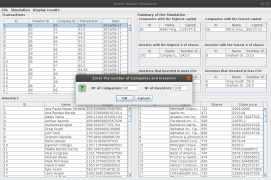 New Simulation
 -
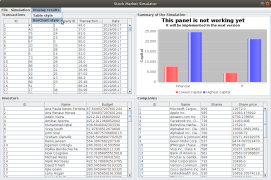 Summary of results (BarChart Style)
 -
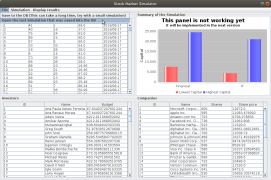 Open File from DB


